
| TBS 353153 Bearing Details: | ||||||||||||||||||
| ||||||||||||||||||
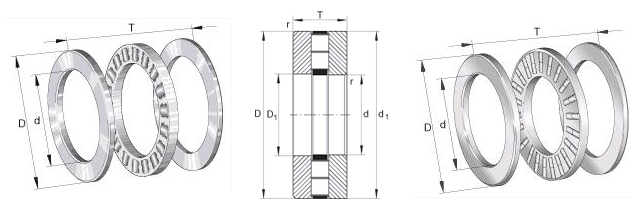
| TBS 353153 Bearing Bearing Size and Drawing: | ||||||||||||||||||
 |
| Model | Inner Diameter d(mm) | Outer Diameter D(mm) | thickness B(mm) | Brand | Type |

Thrust roller bearings (including thrust cylindrical roller, thrust tapered roller, and thrust self-aligning roller bearings) mainly consist of a shaft ring, a housing ring, rollers, and a cage.
They employ a line contact design and offer advantages such as extremely high axial load capacity, good rigidity, impact resistance, and the ability to withstand certain radial loads (thrust tapered roller bearings) or possess self-aligning functionality (thrust self-aligning roller bearings). Compared to thrust ball bearings, their axial load capacity and impact resistance are significantly stronger. Compared to thrust cylindrical roller bearings, thrust tapered roller bearings can withstand additional radial loads, while thrust self-aligning roller bearings can compensate for alignment errors, making them suitable for heavy-duty applications requiring higher load capacity, rigidity, and adaptability to operating conditions. These bearings are primarily used in heavy-load, low-speed, or medium-speed applications requiring the withstand of enormous axial thrust. Typical applications include ship propeller thrust shafts, large vertical turbine main shafts, heavy-duty crane slewing mechanisms, oil drilling rig rotary tables, rolling mill pressing mechanisms, large gearboxes, and hydraulic presses.
