We introduce you to the MRC QJ210 models bearing the relevant parameters, including the model, size, drawings and other models of the same size, if you have any do not understand or want to learn more parameters or would like to inquire about MRC QJ210, please contact us:
admin@tradebearings.com
| MRC QJ210 Bearing Details: |
| Bearing Name | QJ210 |
| New Model | QJ210 |
| Old Model | 176210 bearing |
| product Model | QJ210 |
| Category | Angular Contact Ball Bearings |
| Brand | MRC Bearing |
| Inner Diameter d ( mm ) | 50 |
| Outer Diameter D ( mm ) | 90 |
| Thickness B ( mm ) | 20 |
|
| MRC QJ210 Bearing Bearing Size and Drawing: |
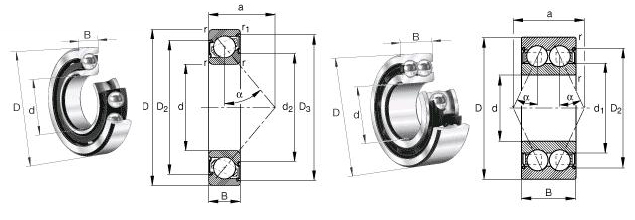 |
MRC QJ210 Bearing With size alternative model
| Model | Inner Diameter
d(mm) | Outer Diameter
D(mm) | thickness
B(mm) | Brand | Type |
| FAG NUP 210 E Bearing | 50 | 90 | 20 | FAG | Cylindrical Roller Bearings |
| KOYO NF 210 Bearing | 50 | 90 | 20 | KOYO | Cylindrical Roller Bearings |
| ZKL N210 Bearing | 50 | 90 | 20 | ZKL | Cylindrical Roller Bearings |
| NACHI 7210 B Bearing | 50 | 90 | 20 | NACHI | Angular Contact Ball Bearings |
| KOYO 6210-RZ Bearing | 50 | 90 | 20 | KOYO | Deep Groove Ball Bearings |
| NSK 30210 Bearing | 50 | 90 | 20 | NSK | Tapered Roller Bearings |
| NSK NSK6210ZZNR Bearing | 50 | 90 | 20 | NSK | Deep Groove Ball Bearings |
| TBS NU 210 E CM* Bearing | 50 | 90 | 20 | TBS | Cylindrical Roller Bearings |
| STEYR 6210-2Z Bearing | 50 | 90 | 20 | STEYR | Deep Groove Ball Bearings |
| TBS *6210-2RZ Bearing | 50 | 90 | 20 | TBS | Deep Groove Ball Bearings |
We export high quantities MRC QJ210 Bearing and relative products, we have huge stocks for MRC QJ210 Bearing and relative items, we supply high quality MRC QJ210 Bearing with reasonbable price or we produce the bearings along with the technical data or relative drawings, It's priority to us to supply best service to our clients. If you are interested in MRC QJ210 Bearing,plz email us
admin@tradebearings.com  What are the structural components and design advantages of angular contact ball bearings?
Angular contact ball bearings consist of an inner ring, outer ring, steel balls, and a cage. The raceways of the raceways are designed with a contact angle (typically 15°, 25°, or 40°) between the bearing rings and the steel balls. They offer advantages such as the ability to simultaneously withstand radial and unidirectional axial loads, high limiting speed, high precision, good rigidity, and the ability to withstand bidirectional axial loads when installed in pairs.
What are the advantages of angular contact ball bearings compared to other similar bearings?
Compared to deep groove ball bearings, angular contact ball bearings have a higher axial load capacity and higher rigidity, making them suitable for precision positioning applications. Compared to tapered roller bearings, they have a higher limiting speed and lower friction, making them more suitable for high-speed operation. Compared to thrust ball bearings, they can simultaneously withstand combined radial and axial loads, and when used in pairs, they maintain high rigidity under bidirectional axial loads without the need for additional radial bearings.
What are the applicable applications and typical uses of angular contact ball bearings?
These bearings are suitable for high-speed, high-rigidity mechanical applications requiring precise positioning and subjected to combined loads. Typical applications include machine tool spindles, automobile wheel hubs, centrifugal pumps, high-speed electric spindles, industrial robot joints, aero-engine spindles, and precision instrument turntables.

